


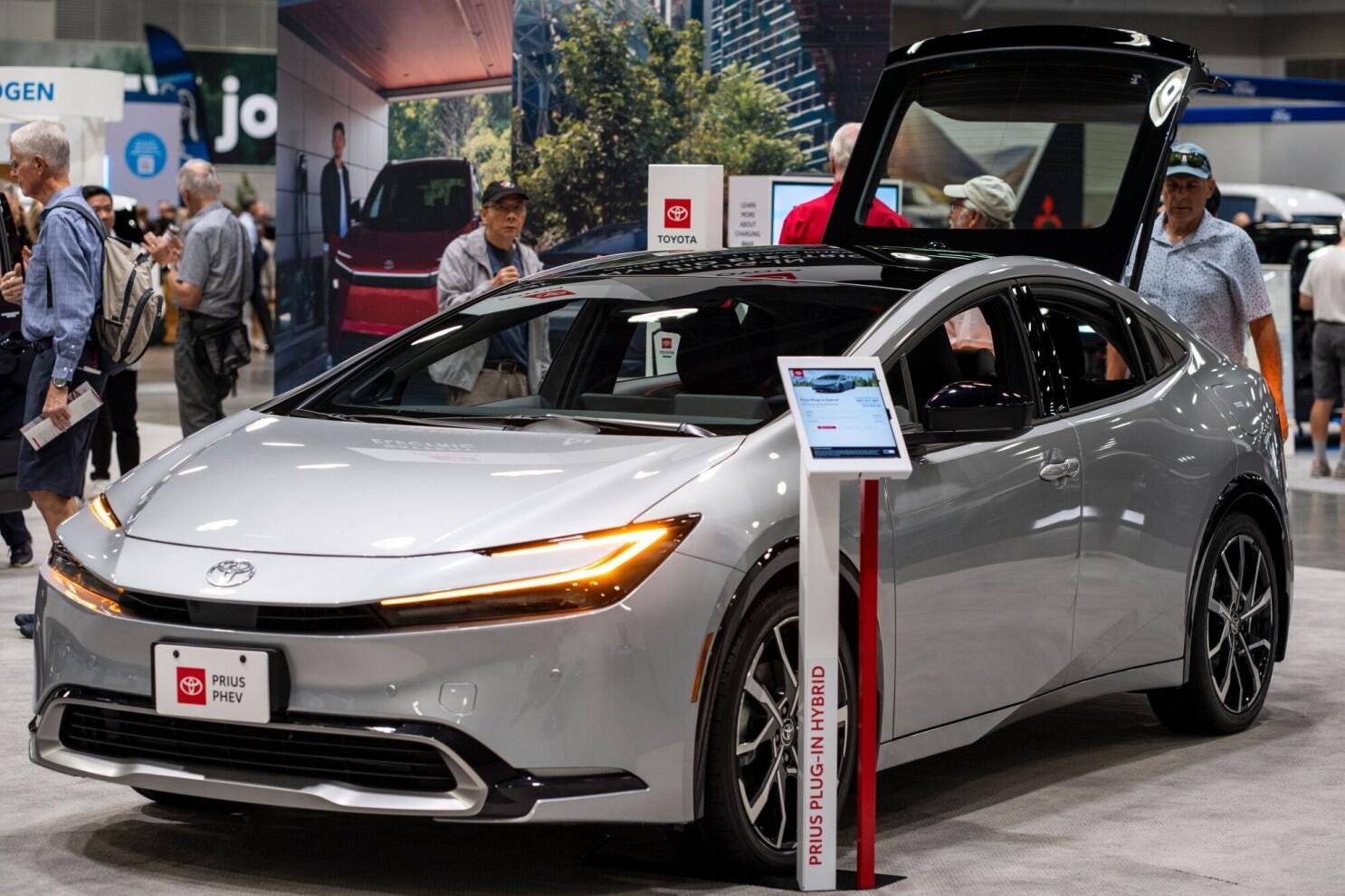
Fifty-three billion dollars is a lot of money. That is roughly what America’s big three automakers (Ford, General Motors, and Stellantis) have now written off on their electric-vehicle ambitions. Put another way, it’s approximately the annual budget for the Commonwealth of Virginia, all wasted in the cause of building cars the American public turned out not to want. In the words of one Detroit insider, this investment constituted “The single biggest capital allocation mistake in the history of the automotive industry.”
Last December, Ford pulled the (proverbial and literal) plug on the electric F-150 Lightning. The F-150 is the best-selling vehicle in American history – and Ford had proudly called the electric version the future of the American automobile. By the time the Lightning was cancelled, Ford’s electric division had already lost around thirteen billion in under three years, more than double what the entire company earned in 2024. GM and Stellantis could tell the same story of billions in losses. What’s striking about this colossal mistake is not that automobile executives misread the market. Rather, it’s that they were lured into that “single biggest capital allocation mistake” by Washington.
Lured may be too weak a word. From the perspective of the Political Vise, the big three got squeezed.
EVs Aren’t the Problem
I have nothing against electric cars. I have many friends who love their Teslas and Rivians and their Chevy Volts. There are plenty of arguments for driving one (the cost of gas not least among them), and if it makes sense to you to buy one, you should be able to do it. In a free market, electric cars would have no trouble finding customers. The problem was that politicians and the environmental lobby made sure that an actual free market was something neither manufacturers nor car buyers could access.
For years, the environmental lobby has heralded electric vehicles as a solution to the climate crisis. If you believe, as that lobby generally does, that the burning of fossil fuels will lead to disastrous global warming, you’ll advocate for anything to wean countries and consumers off those fuels. Though electric car batteries come with myriad environmental consequences of their own, there’s no denying that EVs reduce emissions. And so, going as far back as 2008, environmentalists and their allies in the media have pressured Washington to speed up the pace of electric vehicle adoption. In response, the federal government put its thumb on the scale for a favored technology, regardless of whether the public wanted it or not.
How Washington Rewired the Market
Back in 2022, President Biden’s (woefully misnamed) Inflation Reduction Act upped the pressure considerably, offering Americans $7,500 to buy an electric vehicle. That’s the kind of money you offer when you want to coax the public to do what they otherwise would not. The Biden Administration also rewrote the rules to push automakers to transition to EVs regardless of customer interest. As an added incentive, the Biden Administration slapped tariffs north of a hundred percent on Chinese EV imports. The EV squeeze had three elements: Bribe the buyers, strong-arm the auto companies, and wall off foreign competition. It doesn’t take a degree in economics to see that not only was this absolutely not a free market, but it was a system guaranteed to collapse the moment those bribes disappeared.
These government-generated market distortions hid the true cost from purchasers and lessors alike. The Wall Street Journal reported that thanks to Uncle Sam’s generous subsidies, the average monthly payment on a leased EV had dropped to $538 in the summer of 2025, with several models going for less than a hundred bucks a month. A year later, with that Biden-era credit now expired, that average payment has jumped to $707. A lease on a comparable gas car averages $607. Years of electric vehicles sales were subsidized by taxpayer generosity. (And no one even thanked you!)
With the incentives expired, sales (predictably) collapsed. New EV year-over-year sales and leases fell 36% in a single quarter. In California – one-time home of Tesla and the epicenter of the electric dream – the EV share of new car sales slid by a third. As the Journal reported, for the first time in over a decade, Californians bought more hybrids than EVs.
That Wall Street Journal article also profiled several frustrated consumers. In 2024, Mark and Ida Block leased a brand-new Hyundai Ioniq 6 for less than $340 a month. (A deal that only existed because the rest of us were chipping in.) The Blocks liked the car, but when the lease ran out and the subsidy died, they had no desire to get another EV. They drive a hybrid now, while the pricey charger they installed in the garage hangs useless. Judging by the numbers, the Blocks are far from alone.
The Triumph of Choice
Jim Farley – the CEO of Ford Motor Company and the guy ultimately responsible for cancelling the F-150 Lightning – conceded recently that the end of the $7,500 rebate meant that as a percentage of Ford’s business, EV’s will be “way smaller than we thought.” He added, “We’re following customers to where the market is, not where people thought it was going to be, but to where it is today.” Farley deserves credit for taking responsibility for the decisions made on his watch. And he deserves credit for telling the truth that Ford spent three years and billions of dollars building cars for a market propped up by government pressure rather than organic consumer demand.
Large numbers of car buyers may or may not want to transition to EVs. Ford’s experience proves that either way, very few people want them at the price they actually cost.
The environmental lobby, left-wing media influencers, and their allies in the regulatory agencies could not convince Americans to buy electric cars at market prices. So, they did what they have done for decades, which is turn the levers of the progressive Political Vise instead. Joe Biden’s Washington strong-armed manufacturers, bribed the consumer, and (for several years) sustained a fictional market that wildly distorted supply and demand.
Mark and Ida Block now drive a hybrid of the sort they would have bought all along had the market-wrecking subsidies not been in place. A charger sits useless in their garage, a tangible sign of an investment that did not pay off. The Blocks’ loss is comparatively small. America’s big three automakers and the American taxpayer, on the other hand, are out tens of billions.
Almost none of us asked for this. But all of us paid for it.
We’re from the govt….and here to “help” 😰
All cars have gone up in price, a lot. Manufacturers now must recoup some of the $billions they squandered chasing government mandated/subsidized EVs. Owners coming off EV leases are shocked at what leasing comparable replacement vehicles now cost.
Lost in all the hype over reduced EV fuel and maintenance costs is the reality that the largest single cost of new auto ownership is depreciation....by far. Depreciation directly feeds into lease or finance costs.