

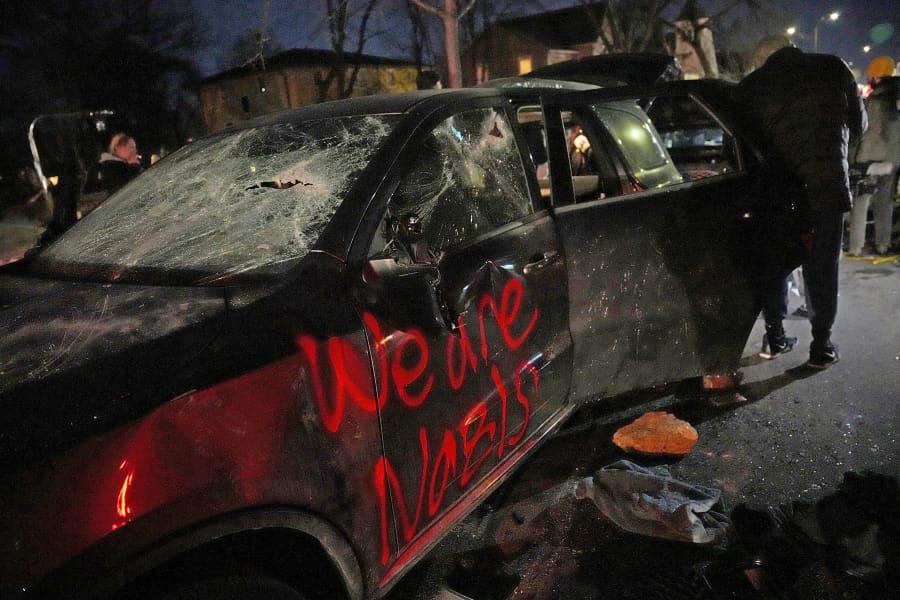
There is a familiar ritual that often follows episodes of political violence in America. We saw it last September, with the assassination of Charlie Kirk. We saw it last week after that fatal confrontation in Minneapolis, when a federal immigration officer shot Renee Nicole Good during an ICE operation. I could name two dozen other instances.
Each time, long before facts are established or motives understood, the press and pundits deployed their favorite and familiar causal explanation:
Rhetoric.
If only our language were softer.
If only disagreements were less sharp.
If only words were chosen with greater sensitivity.
The theory sounds sensible and straightforward. Political violence, the logic goes, is merely a problem of temperature. Lower the heat, and the risk recedes.
After Charlie Kirk’s murder, political commentary converged—within hours—around the idea that his death was the predictable byproduct of “extreme political rhetoric.” Polling from that period showed large majorities, across parties, accepting this explanation. Last week, following Good’s death, we saw the same reflex: institutions rushed past uncomfortable questions and embraced their comforting moral script.
It is an intuitive diagnosis. And it is utterly wrong.
The Myth of Rhetorical Causation
Our leaders embrace the rhetoric narrative because it demands nothing of them. It is cheap. It is easy.
If political violence is caused by “tone,” then the solution is endlessly transferable. Everyone must “do better.” Everyone must “lower the temperature.” Responsibility is evenly distributed and therefore settles nowhere in particular.
This framing performs a novel trick. It transforms a power problem into a vocabulary problem, recasting institutional malpractice as simply a failure of manners.
“Both sides need to calm down.”
“Extremes on both sides are equally dangerous.”
But America’s collapse of civic trust is not symmetrical—and neither is its dehumanization problem.
One side of America’s political divide controls the commanding heights of cultural life: the media, the universities, professional credentialing bodies, major nonprofits, philanthropic foundations, and much of the administrative state.
These institutions do not simply reflect opinion; they decide who is dangerous, who is virtuous, and who may be treated as expendable.
They pretend to offer mere commentary; in reality, they are defining moral legitimacy from their commanding heights.
Violence does not begin with heated speech. It begins when institutions teach the public which lives are worthy of empathy—and which are not. What matters most is not any single outburst or policy decision, but how media, political leaders, and elite institutions work together to decide what beliefs and behaviors are permitted—and which are punished—long before violence occurs.
Dehumanization: The Real Fuel of Political Violence
Here is an uncomfortable truth: Political violence is rarely spontaneous. It is the downstream effect of systems that decide, long before any act occurs, whose actions are excusable and whose are unforgivable.
Political violence becomes inevitable when an elite class declares that those who hold certain views are no longer fully human. That threshold has been crossed.
Since 2020, if not before, our most respected institutions have normalized the idea that certain viewpoints, particularly conservative ones, are not merely wrong but immoral. Those who hold these views are declared “threats to democracy,” obstacles to progress, or agents of active harm.
This moral sorting is not an abstraction. It has life and death consequences.
From the ivory tower and Manhattan newsrooms, Charlie Kirk was caricatured, mocked, and reduced to a symbol of abstract illegitimacy and amorality. When he was murdered, the response was consistent with how the elites had framed Charlie – and his supporters. There was perfunctory, grudging sympathy – quickly followed by lectures about tone.
The Minneapolis case reveals the same moral asymmetry, only from the opposite direction.
In the aftermath of the ICE shooting, networks of activist nonprofits and progressive advocacy groups were treated not as contributors to escalation, but as victims of it. The federal officer was declared guilty long before the facts could be assessed from the full video at multiple angles. Democratic political leaders spoke not of restraint, but of “resistance.” The existence of federal law enforcement itself was framed as ugly provocation, while the violent resistance to that law enforcement was declared alternately innocuous or heroic. In both the Kirk and Minneapolis cases, the common thread is not rhetoric. It is permission.
When institutions repeatedly tell people that certain authorities are inherently illegitimate, that certain laws are inherently immoral, and that their law-enforcing fellow citizens are enemies of justice, they render political violence inevitable.
When they excuse hostility toward one group while moralizing relentlessly about another, they create a hierarchy of dignity.
And when dignity is rationed, violence always follows.
The Role of Institutional Permission
This is where the rhetoric explanation becomes not just wrong, but dangerous.
It directs public scrutiny downward, toward private citizens and their speech, while shielding the institutions that shape moral reality itself.
If rhetoric is the culprit, then citizens must self-censor. But if dehumanization is the cause, then institutions must be confronted – and then, dismantled and rebuilt.
Consider what the Minneapolis episode exposed: a dense web of activist organizations that train citizens to confront law enforcement operations; political leaders who cynically blur the line between civil disobedience and outright obstruction; and a cultural environment in which resistance to the law is treated as inherently virtuous if aimed in the right direction.
None of this requires shouting, and none of it depends on inflammatory epithets.
It depends on moral authorization.
The same dynamic was present in the climate that surrounded Charlie Kirk. Different targets, same mechanism.
What a Healthy Civic Culture Actually Requires
If America wants to reduce political violence, it must abandon the lazy self-indulgence of speech-policing and confront harder truths.
A healthy civic culture requires:
1) Institutional neutrality: Disagreement must be treated as a civic constant, not a cultural threat.
2) Equal moral concern for all citizens: A murdered conservative activist, a left-wing activist killed under tragic circumstances, and a law enforcement officer acting under lawful authority are each deserving of empathy.
3) Consequences for institutional dehumanization: Not legal consequences, but moral and reputational ones. Institutions that strip dignity from those they disfavor must be confronted, not echoed, by their cultural peers.
4)Courageous cultural leadership: The kind that resists fashionable narratives and tells the truth even when it contradicts elite consensus.
The Vise Tightens Only When We Let It
The political vise tightening around our culture is not powered by angry words alone.
It is powered by institutions that distribute compassion to the few and contempt to the many, teaching Americans whom to fear, whom to excuse, and whom to despise.
Charlie Kirk’s death and the surging violence surrounding immigration enforcement are not isolated tragedies. They are not warnings of what may come, but of what is already here.
The more we accept superficial explanations, the tighter the vise becomes.
But the pattern can be broken, not by policing the language of our neighbors, but by demanding moral integrity from the institutions that shape our common life, and by building alternatives when they refuse.
The future does not belong to those who moralize about tone, but to those willing to confront the real causes of our division—and restore a culture that treats every American as fully human.