

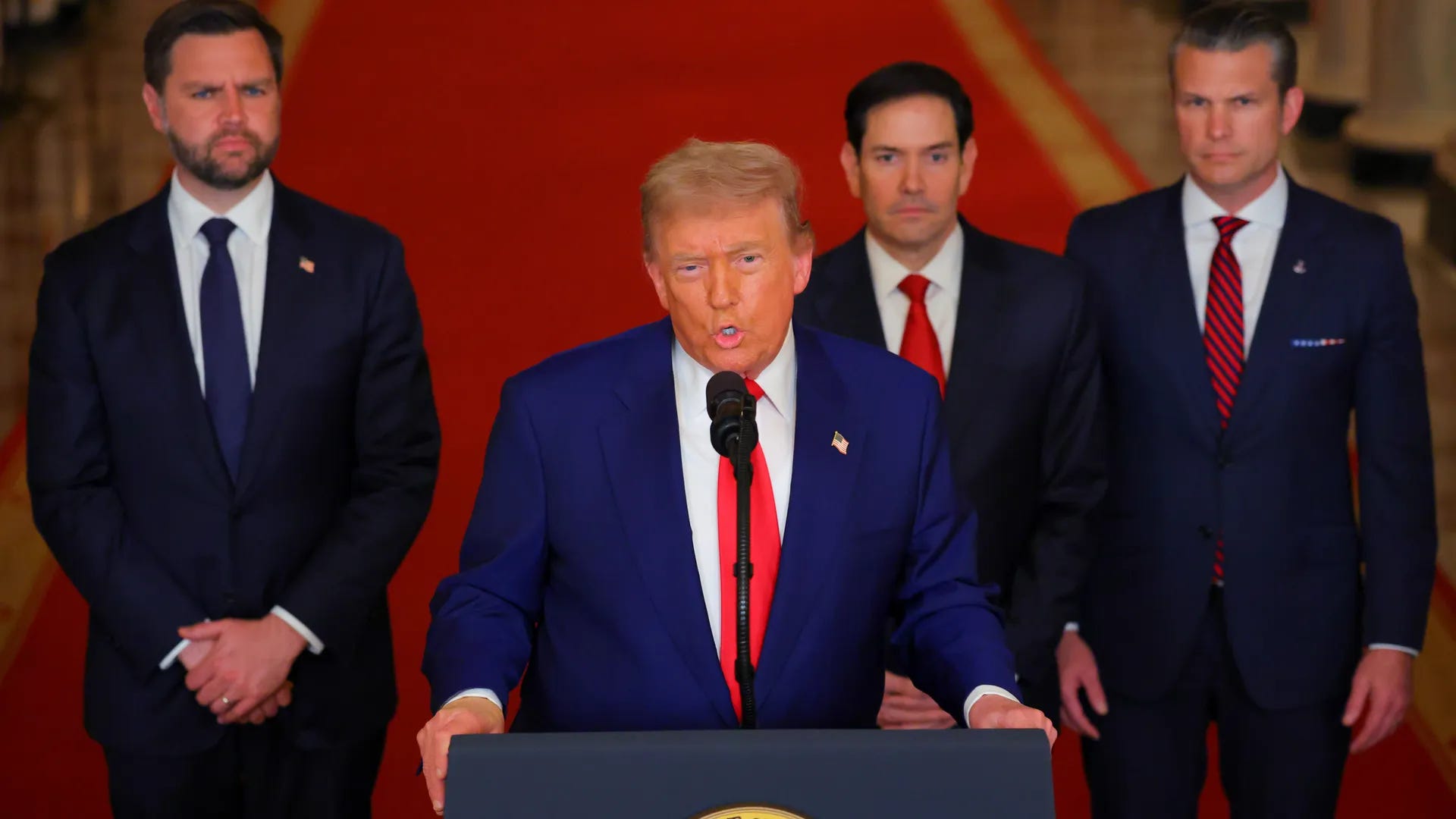
Nine days after the first strikes on Iran, oil crossed $100 per barrel—and the progressive pressure apparatus moved immediately into action.
This was the progressive Political Vise operating in real time. Media, activists, and elite institutions coordinate pressure to squeeze politicians into compliance. Economic consequences become leverage. Political retreat becomes the goal.
Democrats—always eager to score points on the president—pounced. Chuck Schumer blamed Trump’s “reckless war of choice” in Iran. The DNC chair warned that “working families are being crushed.” Representative Tom Suozzi, who supported the initial strikes, now called it a “sugar high” that wasn’t “well thought out.”
The New York Times described how Democrats had “seized” on the oil spike. Note the language: not “responded to” or “raised concerns about.” Seized. For once, the paper of record (presumably inadvertently) described the mechanism of the Vise honestly.
President Trump’s response?
"Prices will drop rapidly when the destruction of the Iran nuclear threat is over. ONLY FOOLS would not see the surging oil costs as a small price to pay for global security."
The progressive Vise failed.
When it comes to Donald Trump, the left can’t generate the unified pressure that normally squeezes presidents into submission. Trump, unlike his predecessors, can fight this action without the concerted sabotage that helped turn Iraq into a quagmire.
The Danger of Relying on One Man
But there’s a cost here. Trump’s boldness and unconventionality—the very qualities that let him stand up to the pressure of the progressive Vise—may be teaching conservatives to forget how the mechanism itself works. And if we don’t learn to operate it ourselves, we’re just watching the left fail without building the organized power conservatives need to produce good outcomes.
In my book The Political Vise, I describe how this mechanism functions. Three sides squeeze the politicians:
Media
The People
Elites (in our institutions).
Good policy decisions get forced out the top. The Vise was designed by our Founders to be the most powerful force in American politics.
From a partisan perspective, the Vise is a neutral mechanism. For decades, progressives mastered it. They seized the commanding heights of American culture and turned them into synchronized pressure points. They squeezed to force withdrawals from Iraq and Afghanistan, to pass Obamacare, and to mandate lockdowns.
Then the pattern began to break. DEI mandates became unpopular liabilities; the Russia collusion narrative fell apart with the Durham findings; and the Twitter Files proved that federal agencies coordinated with tech platforms to suppress speech. The Supreme Court struck down affirmative action. Companies like Meta and Amazon ended their DEI programs. Trump won in 2024 and promptly ended a vast array of federal diversity programs.
So, by the time oil briefly hit $100 and the left began to roll out its Iran messaging, the Vise had lost enough credibility that this attempt at coordinated pressure became visible political theater.
(A word of caution: We shouldn’t be overconfident—the left is a master at manufacturing simulacra of credibility. The progressive Vise is not gone forever.)
Where Is the Conservative Vise?
But watch what’s missing on the conservative side. Many prominent figures on the right openly oppose the conflict in Iran. Others strongly support it. That debate is legitimate. Reasonable conservatives can and do disagree on foreign policy.
Whether conservatives support Trump’s Iran strategy isn’t the point. The real question is both simpler and more profound: Where are conservatives using the Vise on anything?
Look at the issues where conservatives actually agree:
We want the border secured.
We want the regulatory state dismantled.
We want parental control of education restored.
These aren’t controversial among conservatives.
But despite that consensus, there’s little institutional machinery applying sustained pressure to force these outcomes. Heritage releases a report. The America First Policy Institute publishes detailed analysis. Individual governors act. Fox covers it. Conservative podcasters talk about it. While all of this is good and important work, it is too rarely coordinated. (One example of the Vise working for our side? School choice. Aided by the reality of pandemic-era school shutdowns, activists among the American people, many organizations,and solid conservative media support have all coalesced in recent years to exercise the Vise’s pressure and deliver more choice in education.)
The American right hasn’t yet built the machinery.
With satisfaction, we watch the left’s break, but we don’t yet build our own. Progressives spent decades capturing institutions and wielding them as leverage points that could dictate political outcomes, and we’re celebrating the collapse of that system without asking whether we should be learning how it worked in the first place.
Trump’s unconventionality is his strength, as it lets him ignore the progressive Vise where previous presidents always capitulated to the squeeze. That success is easy to misinterpret. Too many on the right think the key to victory is just defying the left’s pressure rather than learning to generate our own.
Building Our Machine
What would it look like if we did?
Think tanks would coordinate research priorities.
Conservative media would amplify the same framework across platforms.
Governors would apply pressure from the states.
Legal organizations would file simultaneous challenges in multiple circuits.
Activists would mobilize at key moments, not randomly but strategically.
Not on every issue—conservatives will still sometimes disagree on tone, tactics, and policy. But on core consensus topics like border security and regulatory reform? Synchronized institutional pressure would make opposing us a career-ending political mistake.
The goal isn’t to silence debate or demand uniformity, but rather to turn conservative consensus into durable policy wins. On the question of whether to pursue regime change in Iran, reasonable people can and will disagree. But the lesson from this moment transcends any single policy decision.
Right now, Donald Trump wins through sheer power of his personality and his willingness to wield executive authority. When he’s gone, what happens? Without institutional pressure sustaining his victories, hard-won progress will vanish the moment progressives rebuild their control. One man defying the Vise isn’t the same as conservatives reclaiming it.
My goal in writing The Political Vise was simple: explain how this mechanism functions so conservatives can reclaim it in service of our nation and our cause. The question isn’t whether Trump’s Iran policy is right. The question is whether conservatives will learn to use the Vise before progressives rebuild their control of it.