

The most important political arguments ask a simple question: how do we best organize society? There are only two real answers, and every aspiring leader proposes a variation on one or the other. Either we build society through coercion, or we do it through persuasion.
The first is the far older, far bloodier way. The second is a comparatively recent development, one that has led to liberty and prosperity for tens of millions. The better path would seem clear – and yet, the partisans of coercion are louder than ever. The threat they pose is existential.
This past New Year’s Day, as he gave his inaugural speech as mayor of New York City, Zohran Mamdani, told his audience that he intended “to replace the frigidity of rugged individualism with the warmth of collectivism.” Collectivism is the ancient arrangement under which the individual is dissolved into the group, and the group is directed from above. Its most infamous twentieth-century practitioners – Stalin, Mao, Pol Pot – killed hundreds of millions. These tyrants used the same rhetoric as Gotham’s grinning new mayor. Though the means they use to enforce power may change, coercion operates on the fundamental principle that government should act in what it imagines to be the best interests of the people, crushing dissent in the name of unity. The people, after all, rarely know what is best.
Customers or Conscripts?
The belief that power should instead be exercised through persuasion is far more recent, dating back only as far as the early Enlightenment. The seventeenth-century philosopher John Locke first explained this idea in full, and the Founders built the American republic on those same principles. The persuasion principle says that the state should be granted narrow (and carefully fenced) authority, exercised only so long as the state continues to enjoy the consent of the governed.
Persuasion is at the heart of our economic system. In private life, endless numbers of entrepreneurs compete to serve people well and win both their trust and their business. They win that business by persuasion rather than force. The grocer does not drag his customers in off the street. Rather, he tries to convince them his bread is good. (He may even blow the scent of fresh baked goods out onto passers-by.) Coca-Cola does not seek to ban Pepsi. It strives instead to make a tastier product.
I’ve spent many years defending liberty – and arguing for persuasion over coercion. There have been times when I’ve felt as if we were close to winning that argument, particularly among young people. This is not one of those times: the American left is in a new ascendancy, led by the likes of Mayor Mamdani. It is troubling enough to see so many fall in love with collectivism, despite its dismal record of poverty and death. What bothers me much more than this naïve infatuation with collectivism? The growing belief that human flourishing is best achieved through coercion.
The Drawbridge Left
When the left is out of power, no one praises open inquiry more loudly. Progressives demand free speech and the chance to march and make demands. They insist on challenging authority, insisting we’re just asking questions! or we only want a debate! Once they are in power, those platitudes about free speech and open competition vanish overnight. For the left, freedom is like a drawbridge. They lower it to get across, then haul it up behind them, ensuring that no one else can follow.
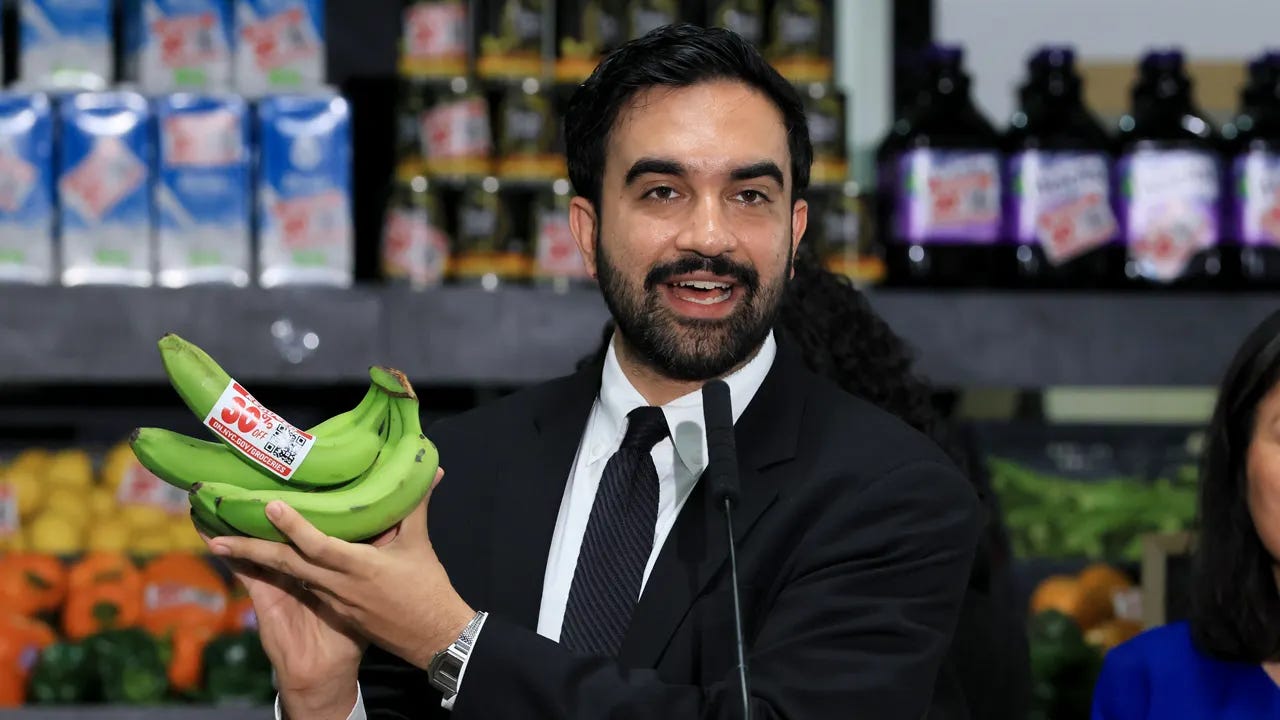
Mayor Mamdani started raising his drawbridge this past Monday. Standing in a Brooklyn grocery store, he announced that New York City would soon open one government-subsidized store per borough, selling meat, milk and produce for thirty percent less than the going market price. The city will own the buildings, forgive the rent, waive the taxes, and cover any losses sustained. At least some of the city’s most vulnerable residents will get a hefty discount on their perishable necessities.
This is straight-up coercion. Yes, the store’s customers will get thirty percent off, but someone else must make up that thirty percent -- along with the rent, the taxes, and whatever the store loses. The “someones” are New York taxpayers, handed a bill for a store they didn’t ask for and may never shop in. They did not consent, and they cannot opt out. Far worse is the coercion of every other grocer save for Mamdani’s chosen few. Most grocers don’t make their living on subsidies. They keep their doors open by persuading the public that their bread is tasty and their produce fresh. Now, these small businesses are compelled to compete against rivals who cannot go broke no matter how poorly they serve the public. Nobody persuaded these small businesses now threatened by Mamdani’s government stores. They will simply be made to comply.
Faith Knows No Footnotes
Whatever Mamdani is, he’s not uneducated. He must know enough history to understand his experiment will fail. The Soviet Union, East Germany, Cuba, and Venezuela all had government-run grocery stores. They also had empty shelves and bread lines as a result. Every time this has been tried –and I do mean every time – the consequence is deprivation. Zohran Mamdani may know this, but he will do it anyway, not merely to keep a campaign promise but because as a true believer, he cannot do otherwise.
Why?
A few weeks ago, I read a terrific article by Zineb Riboua of the Hudson Institute. She studies how hostile regimes and radical ideologies exploit the persuasion-based Western ideal in order to gain power. Riboua explains that creeds of leftism (like the certainty that the government should run grocery stores) are not ideals you hold because of careful, rational inquiry. They are more articles of faith that transcend evidence. You cannot be reasoned out of leftist beliefs because you didn’t use reason to acquire them. And so, when those of us who believe in persuasion marshal our evidence against leftism, citing Stalin’s gulags and Mao’s famines and failed socialist experiments from Havana to Hanoi, the true believer shrugs it off. In this sense, Riboua seems to say, the belief in coercion as an instrument of government policy is rooted in an intractable delusion about human nature. That intractable delusion was on display in that Brooklyn grocery store this past Monday.
Riboua is right that you cannot easily argue a true believer out of his creed. I’ve tried harder than most, and I’ve had a few successes, but not as many as I’d like. We can wait for New York’s experiment to fail, as it surely will at great cost. But we need to do more than look on in resignation, muttering “Told you so” when the whole government grocery regime collapses. We need to focus on persuading the still persuadable. The true believers enraptured by Democratic Socialism may be lost to us, but their neighbors aren’t – at least not yet. Many voters upset about inflation and very interested in cheap groceries can still be reached, particularly if our message marries sound economic truths with real compassion about the soaring cost of living.
When Mayor Mamdani prattles about the warmth of collectivism, he’s selling the comfort of a full shelf on opening day. That warmth won’t last, so what he’s really selling – inevitably – is coercion and deprivation. His is the kind of false and temporary promise that kings and dictators have made for many centuries. Some will believe in it no matter how bad things get. For the rest of us, the time is now to make the case not just for economic liberty, but for a culture and a society rooted in persuasion itself.
I live in Arizona. From what I’ve read, our groceries are much cheaper than those in New York City. I would like to see an article which analyzes what factors make the difference. A rational person who is trying to lower grocery costs would start here and then figure out how to mitigate those higher cost factors.