

The re-election of Donald Trump was a political earthquake. Some eighteen months after he was inaugurated for a second term, the aftershocks are still roiling across the hemisphere. From Central America down to Tierra del Fuego, country after country has moved to the right. In Bolivia, Honduras, Chile, Costa Rica, Peru, and Colombia (the last two nations just this month) conservative candidates have swept to unexpected and often decisive victories.
In little more than a year, an entire political landscape shifted decisively away from the left. But why? The media claims that Donald Trump is unpopular at home and abroad. The mainstream press writes (with barely concealed glee) about the rise of “democratic” socialism here in the United States. So why is Latin America refusing to cooperate with the narrative?
The Political Vise has an explanation. The region’s leftward drift of the last twenty years was far from organic. On the contrary, it was deliberately engineered through American funding and carefully orchestrated pressure.
Comrades in Cartography
On January 20, 2025 – President Trump’s first day back in office – he signed an executive order freezing foreign aid. On March 10, Secretary of State Marco Rubio announced that the Trump administration had concluded its review of the United States Agency for International Development (USAID). Nearly 85% of USAID assistance to Latin America was eliminated.
The American left howled that thousands (or even millions) of vulnerable children in the developing world would starve to death. Secretary Rubio pointed out that a substantial percentage of USAID spending didn’t go to hungry kids, but to the agency’s “Democracy, Human Rights, and Governance” portfolio. That sounds benign. In practice, it meant American money flowed into a political ecosystem that propped up left-leaning candidates and causes across the hemisphere.
That targeted aid may well have even brought down governments. Michael Benz, a former State Department IT chief, has stated repeatedly that if USAID had not existed, the conservative reformer Jair Bolsonaro would still be president of Brazil. Time and again, Benz and other whistleblowers claimed, American funding had been instrumental in defeating right-wing candidates and propping up left-wing regimes.
Claims like that are hard to verify. But there’s absolutely no mistaking what happened as soon as the funding spigot was turned off. The left’s capacity to exert irresistible pressure seemed to vanish overnight, and what quickly followed was a cascade of right-wing electoral victories. In April 2025, Ecuador’s right-wing Daniel Noboa secured a second term. In October 2025, Bolivia elected center-right Rodrigo Paz Pereira, ending nearly two decades of dominance by the far-left. In Honduras last November, Trump-backed conservative Nasry Asfura narrowly defeated his opponents. In December, Chile’s José Antonio Kast won the presidential runoff with 58.2 percent of the vote against a Communist Party candidate. In February 2026, Costa Rica elected conservative Laura Fernández with 48.6 percent in a first-round victory. Peru elected Keiko Fujimori two weeks ago; just this past Sunday, Colombia elected a firebrand populist (and huge Trump fan) named Abelardo de la Espriella. (His nickname is “The Tiger.”)
The left lost every single one of these elections. That wasn’t just because Latin American voters had lost faith in socialism (though they understandably have). The left lost – and continues to lose – because it can no longer rely on borrowed leverage.
Late Communism: Made in America
Since Barack Obama’s first term, American foreign assistance had turned the levers of the Latin American Political Vise. Voters were told they were making choices free of foreign interference. They had no idea that USAID was secretly funding left-wing candidates and their parties. Conservatives faced a very different landscape. Without access to that same USAID cash -- and without media (influencer) support -- right-wing candidates were squeezed out. The moment the American funding disappeared, the Latin American left lost control of the levers of the Vise. The subsequent results, as they say, speak for themselves.
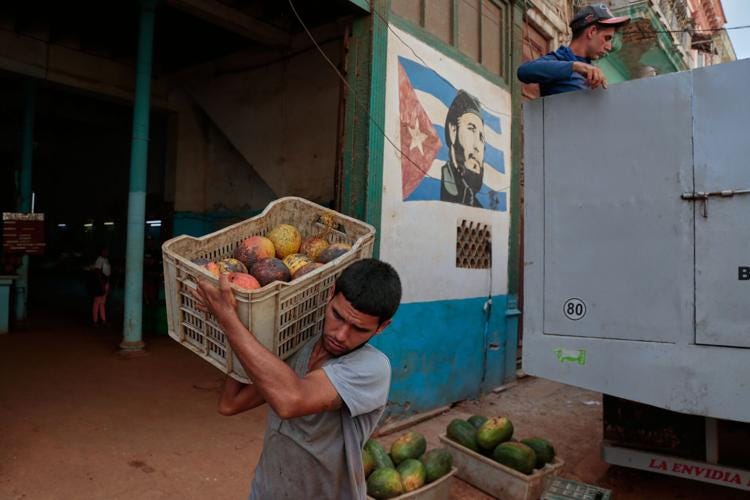
The clearest evidence for all this comes from a surprising place: Cuba.
Along with North Korea, Cuba is one of the world’s last surviving Communist dictatorships. Like North Korea, Cuba has been ruled by one family since the 1950s. For decades, the Castro regime stubbornly resisted market reforms. Even after the Soviet Union fell, and the Cubans lost their primary sponsor, the party apparatus stayed its rigid course. Until, that is, this month.
Just days ago, Cuba’s National Assembly suddenly adopted nearly 200 free-market reforms. According to Prime Minister Manuel Marrero, these measures are intended to dramatically roll back the state’s role in the economy. Foreign investors will no longer be forced to form joint ventures with the state, and for the first time in nearly seventy years, Cuba will welcome large private enterprises. Soon, both Cuban and foreign investors will be allowed to acquire stakes in state companies.
Freedom Never Needs a Subsidy
This is, of course, good news. But why now? You already know: because President Trump has systematically dismantled every external support system propping up far-left regimes. When the Trump Administration eliminated USAID funding to Venezuela—funding that had sustained the government of Nicolas Maduro -- Venezuela’s economy collapsed. When the Trump Administration seized an already-indicted Maduro and brought him to the United States to face trial, the dictator’s successors took the unmistakable hint. They cut off oil to Cuba, and without that oil, the regime was suddenly forced to choose between ideology and survival. The Communist Party chose survival.
Most astonishing of all were the remarks of Cuba’s president, Miguel Diaz-Canel. As his regime adopted these new reforms, he conceded the obvious: Cuba had long been held back by their own system’s structural failings, not by American hostility. The Cuban people were suffering because of a bureaucracy that stifled innovation, punished creativity, crushed dissent, and suffocated entrepreneurs.
In other words, the Cuban president finally admitted that communism does not work.
Socialists won elections in Latin America not because their ideas were better, but because they were able to tap misdirected American aid to fund campaigns and squeeze opponents. Thanks to the Trump Administration, that era has come to a welcome and abrupt end. A new age of freedom and flourishing has arrived in Latin America. We should celebrate it.